
Not every great event requires a big budget, months of planning, or high energy output.
The most impactful gatherings are often the simplest, thoughtfully planned, clearly communicated, and easy to repeat.
This section is designed to help you host events that feel sustainable, aligned, and worth repeating, without burnout.
Use This Section When:
- You want hosting to feel like an extension of your relationships, not a performance
- You want events to feel doable year after year
- You don’t want to reinvent the wheel every time
- You want consistency without overwhelm
The Calm Event Framework
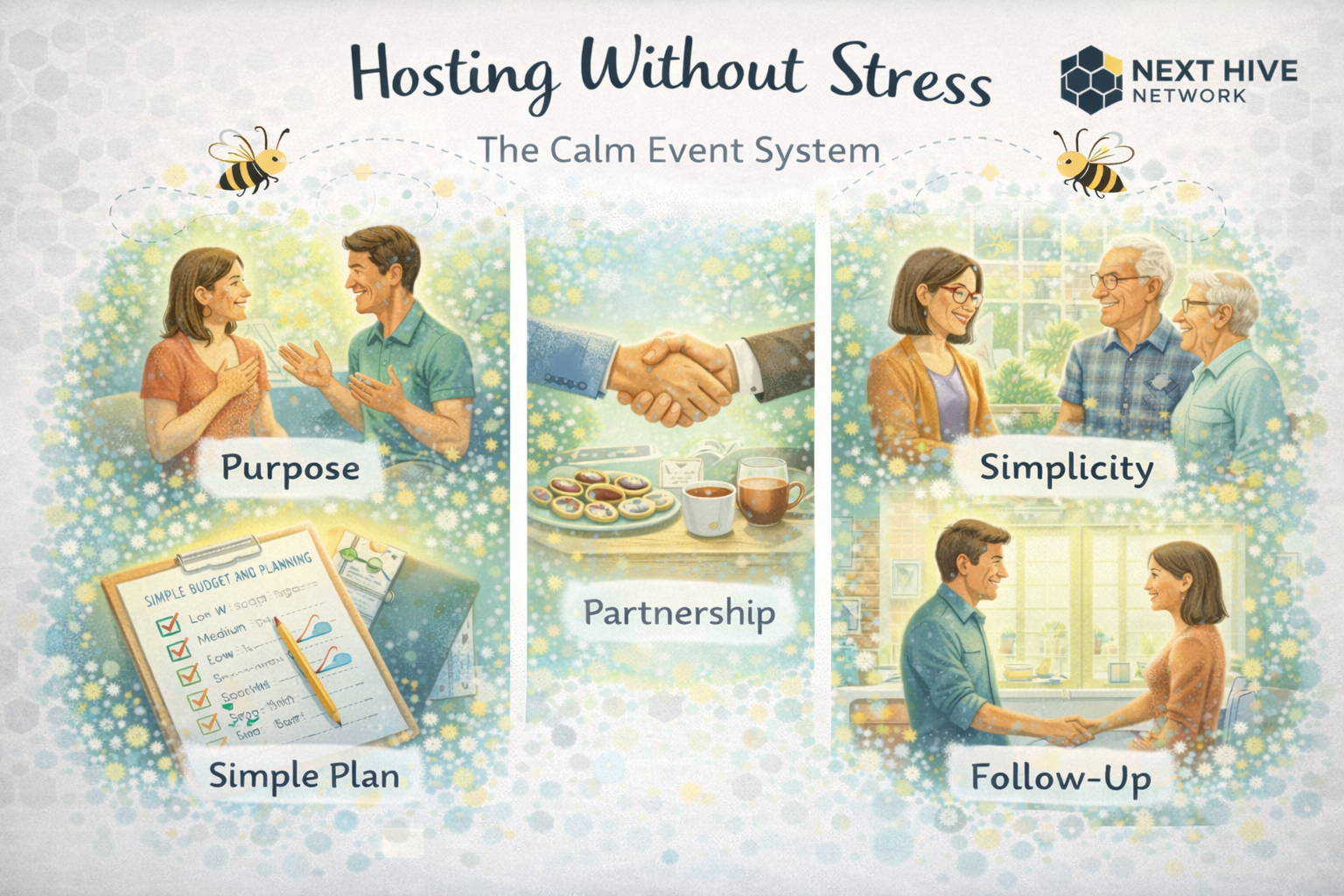
1. Start With the Purpose (Not the Event)
Before choosing what to host, decide why you’re hosting.
Ask yourself:
- Is this about appreciation?
- Connection?
- Education?
- Community service?
When the purpose is clear, decisions become easier, and the event feels grounded.
2. Simple Budget & Planning Templates
Stress often comes from uncertainty. A clear plan removes that.
Keep it simple:
- Choose a comfortable budget range (low, medium, flexible)
- Plan for:
- Location
- One main activity
- Simple food or refreshments
- Build templates you can reuse each year
Rule of Thumb:
If it takes more than a few bullet points to explain, it’s probably too complicated.
3. Vendor Partnerships That Lighten the Load
You don’t have to do this alone.
Smart partnerships can:
- Reduce costs
- Add value for clients
- Share the planning responsibility
Ideal partners include:
- Local cafés or bakeries
- Home service providers
- Fitness instructors
- Pet shops or groomers
- Nonprofits and community organizations
Look for partners who benefit from visibility, not sales pressure.
4. Keep the Event Itself Intentionally Simple
A calm event has:
- One clear focus
- A relaxed schedule
- Room for conversation
You don’t need:
- Full itineraries
- Long speeches
- Multiple activities competing for attention
Less structure = more connection.
5. Hosting Energy Matters
Your tone sets the experience.
Aim to be:
- Present, not busy
- Welcoming, not managing
- Curious, not selling
When you’re calm, guests feel it.
Follow-Up That Feels Sincere (Not Salesy)
The event doesn’t end when people leave, but the follow-up should feel human.
Simple follow-up ideas:
- A thank-you text or email within 48 hours
- A short note referencing something specific
- A photo recap shared privately or socially
- A handwritten note for smaller gatherings
What to avoid:
- Immediate market talk
- Calls to action
- “Let me know if you know anyone” language
Connection first. Everything else follows.
The Calm Event Promise
You don’t need to host more events, you need to host better ones.
When events are:
- Thoughtful
- Repeatable
- Aligned with who you are
They stop feeling like work, and start feeling like relationship care.
A One-Page Calm Event Checklist
Use this checklist for any event, virtual or in-person, to keep planning simple and stress-free.
Before the Event
- ☐ Define the purpose (connection, appreciation, education, service)
- ☐ Choose one clear event type
- ☐ Set a comfortable budget range
- ☐ Select a simple location (or platform)
- ☐ Decide:
- Date
- Start & end time
- Max headcount (optional)
- ☐ Identify any vendor or partner support
- ☐ Draft one invite message
- ☐ Add event to CRM with tags
Week Of the Event
- ☐ Send reminder (email or text)
- ☐ Confirm vendors or supplies
- ☐ Prepare simple signage or name tags (if needed)
- ☐ Create a relaxed arrival plan
- ☐ Set intention: Be present, not perfect
Day Of
- ☐ Arrive early enough to feel calm
- ☐ Greet people personally
- ☐ Focus on conversation, not logistics
- ☐ Take a few photos (optional)
- ☐ Enjoy it
After the Event
- ☐ Tag attendees in CRM
- ☐ Send a thank-you message within 48 hours
- ☐ Make 1–2 personal notes for meaningful conversations
- ☐ Schedule next soft touchpoint
Yearly Event Rotation Planner
(Plan Once. Reuse Every Year.)
This planner helps you avoid decision fatigue by creating predictable, repeatable rhythms.
Quarterly Anchor Events
- Q1 (Winter): Comfort & Care
Examples: Cocoa drop-off, virtual trivia, safety event - Q2 (Spring): Refresh & Renewal
Examples: Plant pop-by, DIY workshop, neighborhood walk - Q3 (Summer): Fun & Light Connection
Examples: Ice cream social, picnic, dog park meetup - Q4 (Fall): Gratitude & Togetherness
Examples: Pie pickup, charity drive, client appreciation note
Optional Monthly Micro-Touches
- Handwritten note
- Pop-by
- Helpful email
- Social DM
- Referral gratitude message
Rule:
One anchor per quarter + one small touch per month = consistency without burnout.
CRM Workflows for Low-Stress Hosting
Your CRM should support calm hosting, not create more work.
Event Setup Workflow
- Create Event Tag:
Event – [Type] – [Season/Month] - Add invite list
- Schedule:
- Invite
- Reminder
- Thank-you
Attendance Tracking
After the event, tag contacts as:
Attended – EventRegistered – No ShowHighly Engaged
Follow-Up Flows
Attended
- Thank-you message
- Optional photo share
- Add note about conversation
No-Show
- Gentle follow-up:
“We missed you, hope to see you next time” - Invite to future low-pressure event
Highly Engaged
- Create task:
- Personal call, voice memo, or handwritten note
- Move to:
High-Trust Sphere
Long-Term Relationship Flow
After 3 events or touchpoints:
- Trigger:
- Personal appreciation message
- Invitation to smaller or more intimate event
This keeps your relationship strategy intentional but effortless.
The best events don’t impress people, they make them feel considered.
When hosting feels calm and intentional, consistency becomes easy, and burnout stays out of the picture.
